
There's this power of 10 called the googol that is 10100; according to the -illion function, it's also called 10 duotrigintillion. ("duotrigint-" meaning "32") There's another power of 10 that you get when you raise 10 to the power of that number mentioned in the previous sentence! It's called the googolplex! It has so many digits that it's way too big to even print out! Unless you use scientific notation. The googolplex must be printed in scientific notation because of its enormous size! So, to show it, just print it like this:
In case you haven't noticed, calculators print scientific notation like this: "1.6777216E19"; here's the exact same number printed in regular form: "16,777,216,000,000,000,000" The "E" stands for "exponent of the power of 10" The same thing is done for negative powers of 10, considering tiny numbers that are greater than zero(0) but less than 1. "0.000 000 654" would be printed as "6.54E-7" in scientific notation. The number of digits after the decimal point tell you which power of 10 to multiply by. For tiny numbers, count the number of zeros before the 1st non-zero digit. (Including the one before the decimal point)
Scientific notation is usually printed like this by humans: "1.6777216 * 1019"; "6.54 * 10-7"
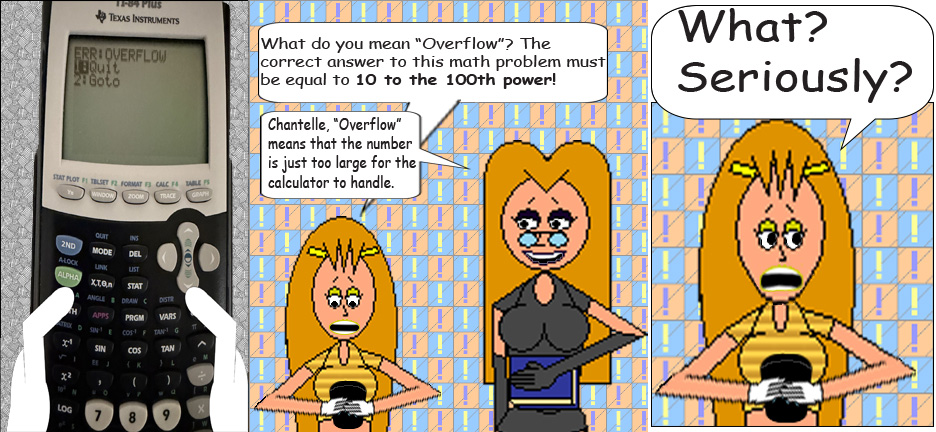
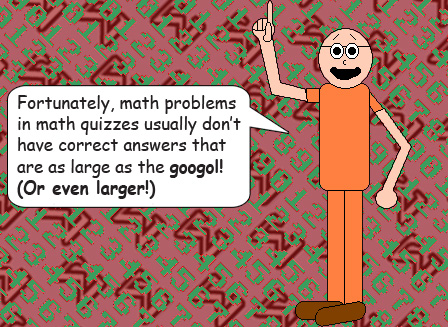
The TI-83 & TI-84 Plus can't count pass the googol, so whenever the answer to the math problem you give it is greater than or equal to 10100, it'll give you an overflow error message!
Here's another limit: The TI-83 & TI-84 Plus always print mixed numbers as decimals if the integer part has at least 4 digits. As for fractions, if the denominator is greater than or equal to 10,000, then it'll print the fraction in decimal form.
Also, unfortunately, the TI-83 & TI-84 Plus can't simplify surds. Surds are irrational radicals printed in simplified form; for example: √(75) = 5√(3); the square root of 75 can be simplified to 5 square roots of 3 since 52 = 25 & 25 * 3 = 75. Irrational numbers are always printed in decimal form on these calculators. However, some specialized calculators can simplify surds so that you can recognize these familiar irrational numbers! Symbolab™ is 1 excellent example! Then again, if you recognize the digits after the decimal point, then you'll know right away what the irrational number is!
I'll mention 1 more limit that the TI-83 & TI-84 Plus have: Considering the googol again, if you raise 10 to the power of the -100 or less, then the TI-83 & TI-84 Plus will answer: "zero(0)"! But that can't be correct! Why does it give you that false answer? Because like I mentioned at the top of the Web page, these calculators can't count past the googol! (And they certainly can't handle the googolplex!) The correct answer is: "10-100" or "1E-100", but considering the negative power of 10, the number is so tiny that the TI-83 & TI-84 Plus see it as insignificant & call it zero(0)! But technically, it's NOT zero(0) but a very tiny number that's greater than zero(0)! The same thing is done on the negative side of the number line. (And every quadrant of the complex number plane)
Back to Index Page Back to Math Trick Menu
© Derek Cumberbatch